1290
The planting legend
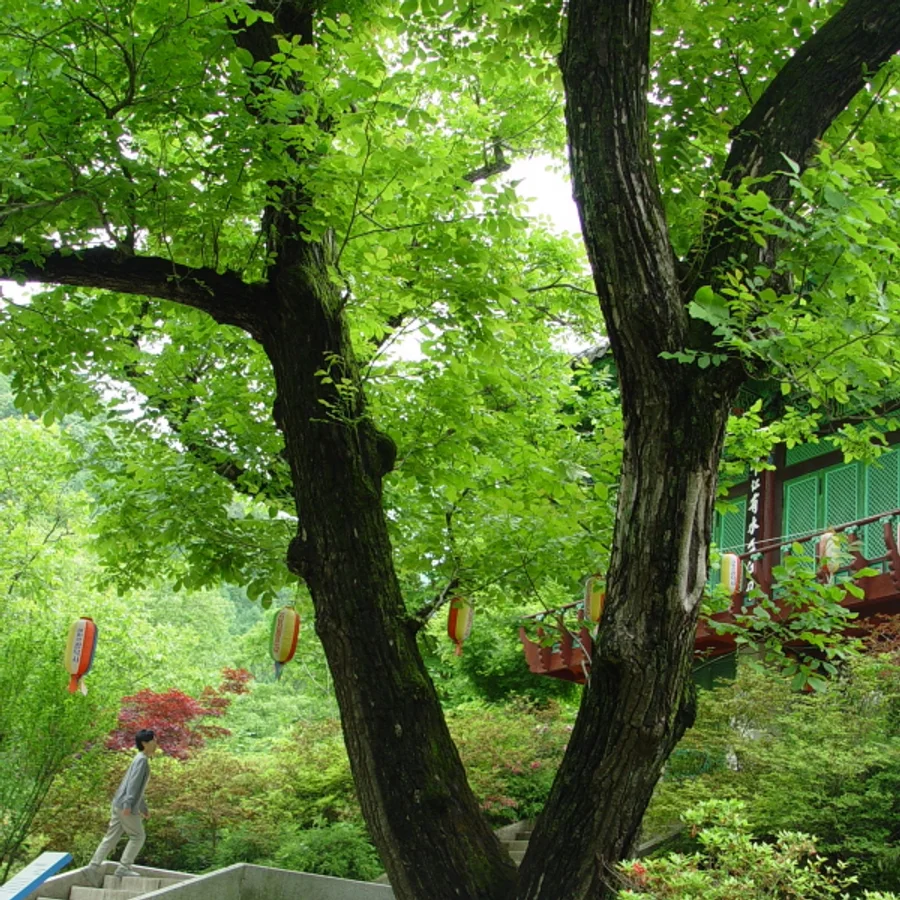
At Gwangdeoksa, a temple in the hills south of Cheonan, there is a walnut tree designated Natural Monument No. 398. It stands 18.2m tall and splits into two trunks about 60cm off the ground, each roughly 2.5m around.
Local tradition holds that in 1290 — the sixteenth year of King Chungnyeol of Goryeo — an official named Yu Cheong-sin returned from Yuan China with walnut seedlings and fruit, planting the seedlings at the temple and the fruit at his family home. The village has called this the country's first walnut planting ever since.The heritage listing is careful about this, and so are we: the tree's age is estimated at around 400 years, which does not reach back to 1290. Whether the tree standing today descends from that planting has not been established. What is established is that walnuts have grown here for a very long time, and that the county built an identity around them.
1931
The earliest record
Hodu-gwaja is a small cake baked in a hinged walnut-shaped mold: a thin batter shell, a filling, and a piece of walnut inside. It is sold hot, in paper bags, usually near a station or a rest stop.
A photograph published in the Joseon Sinmun on 27 September 1931 shows a Cheonan shopfront under a sign reading “Cheonan's famous walnut cake — head store.” The cake was already being sold, and already being marketed as the town's specialty.1934
The founding story
For decades the accepted account was that a couple named Jo Gwi-geum and Sim Bok-sun created it in 1934 at a confectionery near Cheonan Station. That story is still the one most Koreans know.
It has recently been complicated: the 1931 photograph is three years before the date in the founding story. Local historians now treat the 1934 account as the moment the form was popularized rather than invented.We think the honest version is better than the tidy one — a food that has been argued over for ninety years is a food with a history.
Today
What it became
Through the second half of the twentieth century hodu-gwaja spread along Korea's expressways. Rest stops sold it hot by the bag; Cheonan Station sold it to everyone passing through. It became the thing you bring back for the people who did not travel with you — which is still, more than anything else, what it is for.
Sources: Cultural Heritage Administration listing for the Gwangdeoksa walnut tree (Natural Monument No. 398); Digital Cheonan Cultural Encyclopedia, “The introduction of the walnut and Cheonan's famous walnut cake”; Joseon Sinmun, 27 September 1931.