Plant → cold chain → counter

Made once.
Baked everywhere.

What spends its life at −18°C is the batter and the filling, never a finished cake. The part a customer sees, the hot part, takes about three minutes and happens in front of them.

Batter & filling
−18°C
Mold
180–190°C
At the counter
~3 min
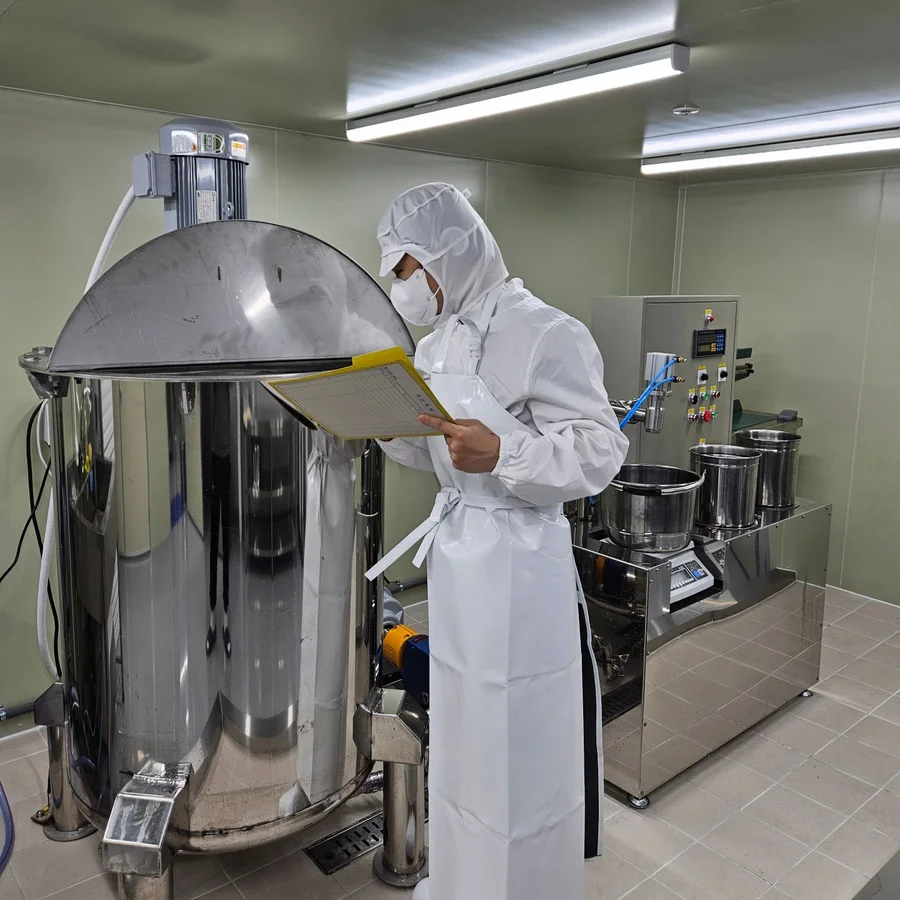
An operator in full sanitary gear checking a record sheet beside a stainless mixing tank at the HACCP-certified plant
Our HACCP-certified plant
1
HACCP-certified plant
−18°C
Held through distribution
3min
Baked to order in store
46
Locations listed in Korea
180–190°C
Mold temperature
  1. 01

    Batter and filling

    Ambient

    Mixed at a HACCP-certified facility, not in each shop.

    One recipe and one process for the whole network — the reason every store tastes alike.

  2. 02

    Frozen

    −18°C

    Brought down and held at −18°C.

    Freezing is what buys shelf life and consistency at the same time.

  3. 03

    Overnight logistics

    −18°C

    Moved nationwide on a cold chain, dawn delivery even to Jeju.

    The cold chain is unbroken from the plant to the store freezer.

  4. 04

    Store freezer

    −18°C

    Held frozen until the moment it is needed.

    Nothing is baked ahead into a warming cabinet.

  5. 05

    The mold

    180–190°C

    Batter, walnut and filling go into a cast walnut-shaped mold at the counter.

    This is the first point where heat enters the process.

  6. 06

    About three minutes

    180–190°C

    Baked to order while the customer waits.

    Small batches as orders come in, so nothing sits.

  7. 07

    Paper bag

    Hot

    Handed over hot.

    The whole system exists so this last step is the same in Incheon, Gumi or Ho Chi Minh City.

Why split it this way

Production sits upstream and baking sits downstream. A new partner therefore learns the last two stops on this route, not the whole of it.

What the plant handles

Recipe, process and controls sit in one place. Ganghwa mugwort, Goheung yuzu and Ongjin sweet potato are worked into fillings there, not improvised in store.

What the store handles

Mold temperature, portioning and timing. The in-store process is designed to be straightforward to train and to run, and stores bake in small batches as orders come in.

What this means for a partner

  • The system is designed to reduce the production infrastructure a partner has to build locally. Requirements still vary by market and local food regulation.
  • The taste a customer gets abroad is the taste the plant made.
  • Menu changes ship as new fillings, not as new equipment.

Master franchise terms →

Global partnership

Ask about the supply chain

Cold-chain requirements, lead times and volumes for your market.

Prefer email? official@anghodu.com